Astro Cultivators is a collaborative project developed as part of the NASA Autonomy Research Center for STEAHM, also known as ARCS, at California State University, Northridge. ARCS connects student work with NASA, JPL, and industry partners through projects related to autonomy, robotics, science, and space focused systems.
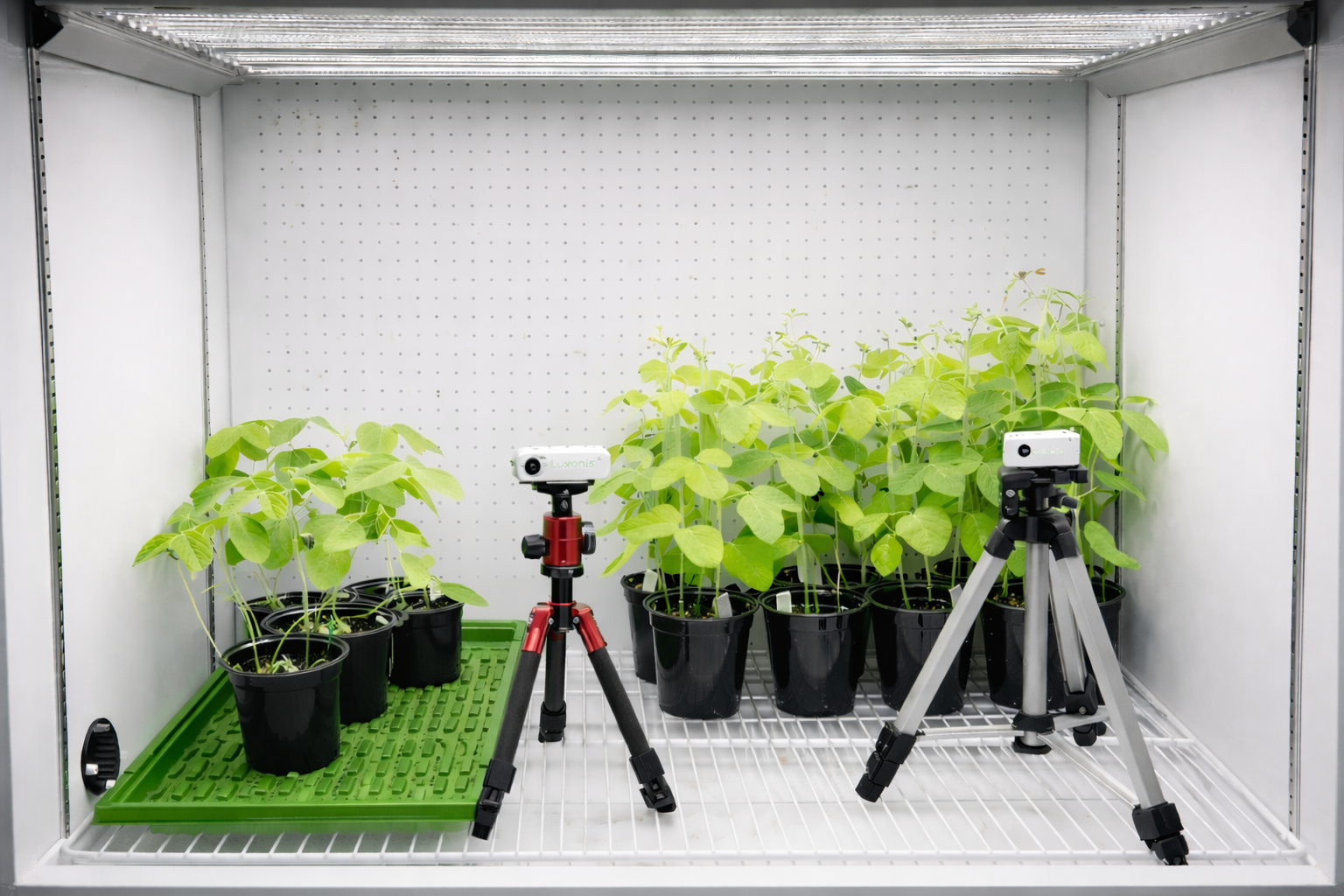
In this project, we built an imaging and analytics pipeline for early drought stress detection in Williams 82 soybean seedlings using hyperspectral images, RGB images, and 16 bit raw depth images collected from controlled growth chamber experiments.
The project connects plant stress monitoring with the larger goal of autonomous farming for space environments. Our work supports the use of cameras, machine learning, and robotic systems to monitor crop health before stress symptoms become visually obvious.
The final pipeline includes dataset organization, preprocessing, feature engineering, temporal analysis, stress detection and classification, and data visualization. These outputs can support future integration into a digital twin system, where plant health data can be visualized and monitored in a virtual growth environment.
Overall, the goal is to support non destructive soybean stress monitoring for space farming, controlled environment agriculture, and future autonomous plant growth systems.
Hyperspectral, RGB, and depth images are used to capture plant color, spectral response, area, height, and structure.
Machine learning and temporal analysis are used to classify drought stress, track daily plant changes, and identify early stress patterns over time.
The project produces feature CSVs, model results, onset detection, segmentation overlays, charts, and dashboard views.
Overview of hyperspectral, RGB, and depth datasets collected across calibration and drought experiments.
Cleaning files, validating images, filtering frames, matching raw depth data, and preparing plant masks.
Extracting vegetation indices, VARI, area, height, canopy volume, roughness, and daily change features.
Benchmarking 12 classifiers and using an MLP model for control versus drought stress classification.
Tracking daily feature changes and detecting stress onset before clear visual symptoms appear.
Visualizing masks, model outputs, time series charts, control versus drought comparisons, and dashboards.

Temporal Growth Analysis
Computer Science Graduate Student, ARCS associate, and Process Analyst @ Ingram Micro. In Astro Cultivators, she contributed to hyperspectral based soybean drought stress monitoring, helped connect the biology and data science teams, and supported experimental design, data organization, and machine learning work using hyperspectral, RGB, and depth imagery.



Team Lead
B.S. Computer Science, ARCS Associate, NSF Researcher, Dean's List honoree, and IEEE HKN member. In Astro Cultivators, she led the team and built the RealSense RGB and depth pipeline, feature extraction workflow, model benchmarking, MLP stress classifier, and onset analysis.

Data Cleaning and Preprocessing
B.S. Computer Science with a Mathematics minor, ARCS Associate, math tutor, published writer, fitness instructor, and piano teacher. In Astro Cultivators, she focused on hyperspectral data cleaning, preprocessing, band validation, NDVI masking, and metadata generation.

Data Preprocessing and Feature Engineering
B.S. Computer Science, ARCS Associate, Technical Operations Intern and Scrum Master at CSUN Associated Students, and Product and Systems Manager at ETHIX. In Astro Cultivators, she worked on hyperspectral preprocessing, data quality assessment, and vegetation index feature engineering.

Data Visualization
B.S. Computer Science, ARCS Associate, and software developer with experience in JavaScript, React, Python, Node.js, and cloud infrastructure. In Astro Cultivators, he built hyperspectral dashboard and visualization components.
The tools, frameworks, and expertise powering our plant stress detection pipeline.
Core language for data preprocessing, feature extraction, machine learning, and visualization.
Used with Grounded SAM 2 and SAM 2.1 for zero shot plant segmentation.
Used for image processing, HSV refinement, mask cleanup, and RealSense feature extraction.
Used for classifier benchmarking, StandardScaler, MLPClassifier, and evaluation metrics.
Used for numerical computing, feature tables, daily aggregation, and CSV outputs.
Used for NDVI maps, spectral plots, confusion matrices, and growth trend charts.
Used for exploratory analysis, preprocessing, feature engineering, and model experiments.
D435 camera system used for RGB and 16 bit raw depth image collection.
Used for interactive dashboard components and plant monitoring visualizations.